
Plasma-Wet Abatement Systems
High-efficiency point-of-use gas abatement systems for semiconductor, solar and flat-panel display manufacturing, with treatment capacities from 600 LPM to 3,000 LPM.
Effective Treatment for Demanding Process Gases
NexClean Gemini plasma-wet abatement systems use high-temperature DC arc plasma to thermally decompose stable and hazardous process gases.
After plasma treatment, the exhaust passes through wet washing and filtration stages that help capture water-soluble gases, reaction byproducts, particulates and water mist.
- Designed for semiconductor Etch and CVD processes
- Suitable for solar and photovoltaic manufacturing
- Supports flat-panel display production
- Standard and high-volume treatment capacities
How Plasma-Wet Abatement Works
Two complementary treatment stages help manage difficult process gases and their reaction byproducts.
Plasma Decomposition
Process gases enter the reaction chamber, where high-temperature plasma provides intense localised energy to break down stable compounds such as CF₄, NF₃ and SF₆.
Wet Scrubbing
Post-decomposition gases pass through wet washing and filtration stages that help capture water-soluble reaction byproducts, particles and water mist.
Why Choose NexClean Gemini?
Plasma-wet technology provides scalable point-of-use treatment for demanding semiconductor and advanced manufacturing processes.
Dual-Stage Treatment
Plasma energy decomposes difficult gases before wet scrubbing manages soluble gases and reaction byproducts.
Wide Operating Range
Capacities range from 600 LPM for standard applications to 3,000 LPM for high-volume exhaust streams.
Compact Integration
Space-efficient configurations support integration into semiconductor sub-fab and manufacturing facilities.
Utility Management
Controlled nitrogen, process cooling water and compressed dry air requirements help manage operating costs.
Plasma-Wet Abatement Applications
Engineered for process exhaust treatment across advanced manufacturing environments.

Semiconductor Manufacturing
Point-of-use treatment for Etch and CVD processes involving perfluorinated and other hazardous process gases.

Solar and Photovoltaic
High-throughput gas abatement for coating, deposition and solar-cell fabrication processes.

Flat-Panel Display
Scalable process-gas treatment for large-area substrate and display-panel manufacturing operations.
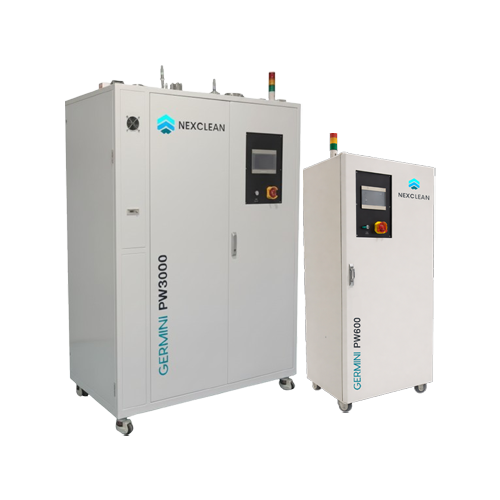
NexClean Gemini Plasma-Wet Models
Compare the compact PW600 with the higher-capacity PW3000.

NexClean Gemini PW600
A compact plasma-wet abatement system for standard-capacity semiconductor, solar and display manufacturing applications.
| Type | Plasma-Wet |
|---|---|
| Capacity | 600 LPM |
| Dimensions | 920 × 835 × 1,906 mm |
| Weight | 540 kg |
| Inlets | 6 × KF40 |
| Process exhaust | ISO 100 |
| Cabinet exhaust | ISO 100 |
| Target gases | CF₄, NF₃, SF₆ and others |

NexClean Gemini PW3000
A high-throughput plasma-wet abatement system for larger process exhaust flows and demanding fabrication lines.
| Type | Plasma-Wet |
|---|---|
| Capacity | 3,000 LPM |
| Dimensions | 1,300 × 1,135 × 2,030 mm |
| Weight | 750 kg |
| Inlets | 4–8 × KF40 or 4–6 × KF50 |
| Process exhaust | ISO 160 |
| Cabinet exhaust | ISO 100 |
| Target gases | CF₄, NF₃, NH₃, SF₆, SiH₄ and others |
Specifications and suitable gas configurations should be confirmed according to actual process and facility requirements.
Plasma-Wet Abatement FAQs
What is a plasma-wet abatement system?
It uses high-temperature plasma to decompose process gases before passing the exhaust through wet scrubbing stages that capture soluble byproducts and particles.
Which industries use plasma-wet abatement?
Plasma-wet systems are commonly used in semiconductor, solar, photovoltaic and flat-panel display manufacturing, including Etch and CVD applications.
What is the difference between PW600 and PW3000?
The PW600 provides a 600 LPM treatment capacity in a more compact configuration. The PW3000 supports up to 3,000 LPM for higher-volume process exhaust streams.
How do I select the correct system?
Selection depends on gas types, concentrations, exhaust flow, process equipment, inlet configuration and available utilities. Camda Engineering can review these requirements.
Looking for a Plasma-Wet Abatement Solution?
Share your process gas types, exhaust flow, inlet requirements and facility conditions with our technical team.