
Industrial Adsorption Air Dryers
Energy-efficient compressed-air drying systems for semiconductor, battery, solar and precision manufacturing applications across Southeast Asia and India.
Protect Critical Production from Moisture
Moisture in compressed air can corrode pipelines, interfere with pneumatic equipment and contaminate moisture-sensitive processes. Camda Engineering supplies Zinger adsorption air dryers designed to maintain stable compressed-air quality while reducing unnecessary purge losses and energy consumption.
Available configurations support pressure dew points from −40°C to as low as −90°C, subject to system design and operating conditions.
Unlike refrigerated dryers, adsorption air dryers can achieve the very low pressure dew points required by advanced manufacturing. This makes them suitable where even a small amount of residual moisture could affect product quality, damage instrumentation or create instability in a production process. Correct sizing is important: inlet temperature, operating pressure and peak air demand all influence the amount of moisture that the dryer must remove.
- Flow capacities from 1.5 m³/min to 630 m³/min
- Blower-heated and water-cooled configurations
- PLC and touch-HMI operating visibility
- Solutions for Southeast Asia and India
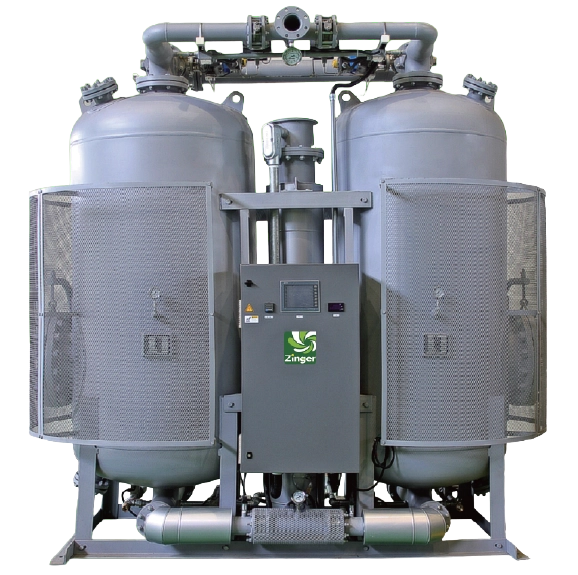
How Adsorption Air Dryers Work
Twin-tower operation provides a continuous supply of dry compressed air.
Moisture Adsorption
Compressed air passes through a vessel containing desiccant, which attracts and retains water vapour before the treated air enters production.
The top-to-bottom process-flow arrangement helps compact the adsorbent, reduce dust disturbance and support longer downstream filter life.
Desiccant Regeneration
While one tower dries the air, the second tower regenerates. The towers alternate automatically to maintain continuous operation.
Heating releases the retained moisture and a controlled cooling stage prepares the regenerated vessel for its next adsorption cycle, helping prevent dew-point spikes.
Why Choose Zinger Adsorption Air Dryers?
Efficient regeneration and dependable dew-point control help protect production while managing compressed-air operating costs.
Energy-Efficient Operation
Regeneration methods are designed to reduce compressed-air losses compared with conventional heatless systems.
Stable Dew-Point Control
Configurations support pressure dew points from −40°C to −90°C for demanding production environments.
High-Capacity Options
A broad flow range supports individual production lines and large central compressed-air facilities.
Smart Monitoring
PLC and touch-HMI controls provide visibility of temperature, pressure, operating status and dew point.
Air Dryer Applications
Dry compressed air for advanced and moisture-sensitive manufacturing processes.
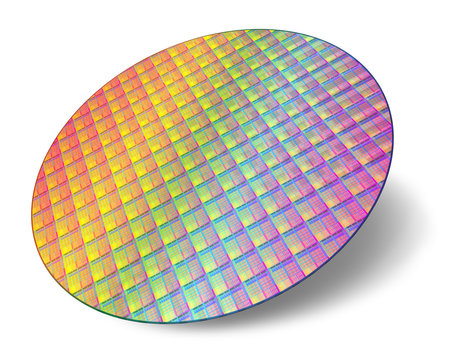
Semiconductor Manufacturing
Stable dry air for wafer fabrication, packaging, testing and supporting pneumatic systems.

EV Battery Production
Compressed-air treatment for battery production, specialised coating and moisture-controlled processes.

Solar, Display and Optics
Dry compressed air for photovoltaic cells, LCD panels, optoelectronics and precision optical components.
How to Select an Industrial Adsorption Air Dryer
Selecting an air dryer solely by compressor capacity can lead to poor dew-point performance or unnecessary energy consumption. Camda Engineering reviews the complete operating profile so the proposed system can meet both present production demand and reasonable future expansion.
Flow and Pressure
Provide normal, maximum and minimum compressed-air flow together with operating pressure. Peak demand, pressure fluctuation and any planned production expansion should be considered when establishing the required dryer capacity.
Inlet Conditions
Higher inlet temperature increases the moisture load entering the dryer. Ambient conditions, upstream aftercooler performance and condensate separation should therefore be reviewed before selecting the adsorption vessels and regeneration arrangement.
Required Dew Point
A −40°C pressure dew point suits many industrial applications, while semiconductor, battery and other moisture-critical processes may require −70°C or −90°C. The target should reflect the actual process requirement rather than an unnecessarily low specification.
Utilities and Lifecycle Cost
Available electrical power, cooling water, installation space and acceptable CDA purge consumption determine whether A-Type or W-Type is more appropriate. The assessment should consider ongoing energy use as well as the initial equipment cost.
Zinger Adsorption Air Dryer Configurations
Compare blower-heated A-Type and water-cooled zero-purge W-Type systems.
A-Type Blower-Heated Air Dryer
Uses externally heated ambient air to regenerate the desiccant, reducing compressed-air consumption compared with conventional heatless dryers.
External air heating can reduce CDA used for desorption by more than 80% compared with a heatless dryer, according to the product brochure. Internal waste-heat utilisation and adjustable regeneration control help optimise heater and blower consumption. Fully controlled cooling helps minimise residual moisture before the regenerated tower returns to service.
| Configuration | Blower heated, air cooled |
|---|---|
| Flow range | 1.5–630 m³/min, subject to model |
| Pressure dew point | −40°C standard; lower options available |
| Purge demand | Low compressed-air purge |
| Controls | PLC and touch HMI |
| Best suited for | Efficient, reliable general industrial drying |
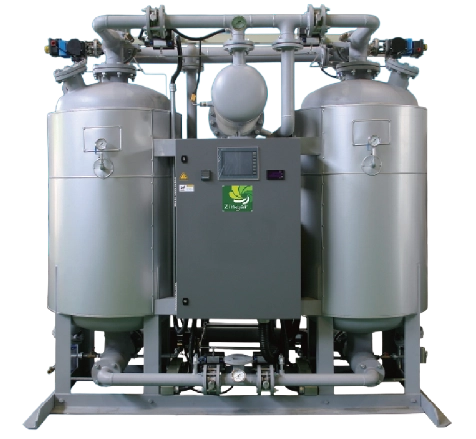
W-Type Water-Cooled Air Dryer
Uses water cooling during regeneration to eliminate compressed-air purge loss for high-capacity plants focused on maximum CDA utilisation.
The W-Type is designed for facilities where compressed air is a valuable production utility and purge loss should be avoided. Its water-cooled regeneration arrangement supports continuous dry air delivery while automatic controls monitor operating status, temperature, pressure and dew point. Protection functions can prioritise air supply, pressure-drop control and overheating safety.
| Configuration | Water-cooled regeneration |
|---|---|
| Flow range | Configured for high-capacity requirements |
| Pressure dew point | −40°C standard; down to −90°C available |
| Purge demand | Zero compressed-air purge loss |
| Controls | PLC and touch HMI |
| Best suited for | Large plants prioritising CDA efficiency |
Specifications and final configuration should be confirmed according to actual operating and facility requirements.
Industrial Air Dryer FAQs
What is an adsorption air dryer?
An adsorption air dryer uses desiccant to remove water vapour from compressed air. It is suitable for processes requiring lower pressure dew points than refrigerated dryers typically provide.
What pressure dew point can these systems achieve?
Systems are available for approximately −40°C pressure dew point, with options reaching as low as −90°C depending on configuration and operating conditions.
What is the difference between A-Type and W-Type?
A-Type uses blower-heated ambient air with low purge demand. W-Type uses water cooling and is designed for zero compressed-air purge loss.
How do I select the correct air dryer?
Selection depends on flow, pressure, inlet temperature, required dew point, ambient conditions, cooling-water availability and allowable purge consumption. Camda Engineering can review these requirements.
Why is pressure dew point important?
Pressure dew point indicates the temperature at which moisture would condense at the compressed-air operating pressure. A lower value means drier air. Maintaining the correct pressure dew point helps prevent corrosion, product contamination, pneumatic-equipment problems and unexpected moisture entering sensitive production processes.
What maintenance information should be considered?
Routine maintenance may include checking filters, drains, valves, dew-point instruments, heaters, blowers and cooling-water conditions, together with periodic desiccant assessment. Maintenance frequency depends on operating hours, inlet-air quality and site conditions. Recording dew-point and pressure trends can help identify deterioration before it affects production.
What is the difference between an adsorption air dryer and a refrigerated air dryer?
A refrigerated air dryer cools compressed air to remove condensed moisture and is generally suitable for applications with moderate dryness requirements. An adsorption air dryer uses desiccant to remove water vapour and can achieve much lower pressure dew points, making it more suitable for semiconductor, battery, electronics and other moisture sensitive processes.
What information is required to size an adsorption air dryer?
Important information includes normal and maximum air flow, operating pressure, inlet temperature, ambient conditions, required pressure dew point and daily operating hours. Cooling water availability, electrical supply, installation space and expected future capacity should also be considered.
How does inlet temperature affect air-dryer performance?
Warmer compressed air can carry more water vapour, increasing the moisture load entering the dryer. If the inlet temperature exceeds the design condition, the dryer may not achieve its intended pressure dew point. Proper aftercooling and condensate separation are therefore important before the air enters the adsorption dryer.
How long does the desiccant in an adsorption air dryer last?
Desiccant lifespan depends on operating hours, inlet-air quality, temperature, pressure and exposure to oil or liquid water. Proper filtration, drainage and scheduled maintenance can extend its service life. Dew-point trends and desiccant condition should be monitored to determine when replacement is necessary.
Can an industrial air dryer be customised for my facility?
Yes. Adsorption air dryers can be configured according to flow capacity, pressure, target pressure dew point, regeneration method, cooling-water conditions, electrical requirements, communication protocol and installation constraints. Camda Engineering can review your operating data and recommend an appropriate configuration.
Looking for an Industrial Air Dryer?
Share your compressed-air flow, operating pressure, inlet temperature and required pressure dew point with our team.